
One sentence comes up in almost every meeting where something has to be decided.
"We don't have enough to go on yet."
Sometimes it is accurate. A piece of data is missing, it will arrive, we wait. But often, once you dig a little, you find that the missing piece does not exist, that it will never arrive, and that everyone around the table already knows it.
What is being waited for is not information. It is cover.
What usually blocks things
What is missing gets confused with what will never exist. Some information can be obtained: a study, an audit, a test on a narrow perimeter. Other things will only be known afterwards, because they depend on what a competitor, a regulator or a client decides to do. Both end up filed under "pending", and the second blocks the first.
Certainty is demanded from a level that cannot produce it. A technical team can say whether a system will hold under load. It cannot say whether the market will exist in three years, and that is not its job. When the question comes down anyway, it comes back as a long, careful document that helps nobody decide.
The person deciding is protected by diluting the decision. One more committee, one more opinion, one more sign-off. In the end nobody has really decided, and nobody is really exposed. It feels comfortable at the time. It becomes expensive the day someone has to explain why nothing moved.
I am not saying this from above. We all do it, myself included, and usually without noticing.
What changes when uncertainty is named
The exercise I suggest is simple and fits into one meeting.
Take the decision on hold and sort what you do not know into three columns.
What can be known before deciding, with the time and the cost of obtaining it. What will only be known by moving, which calls for a reversible step rather than a study. What will never be known in time, and has to be carried as a bet, with a written note of what would make you change your mind.
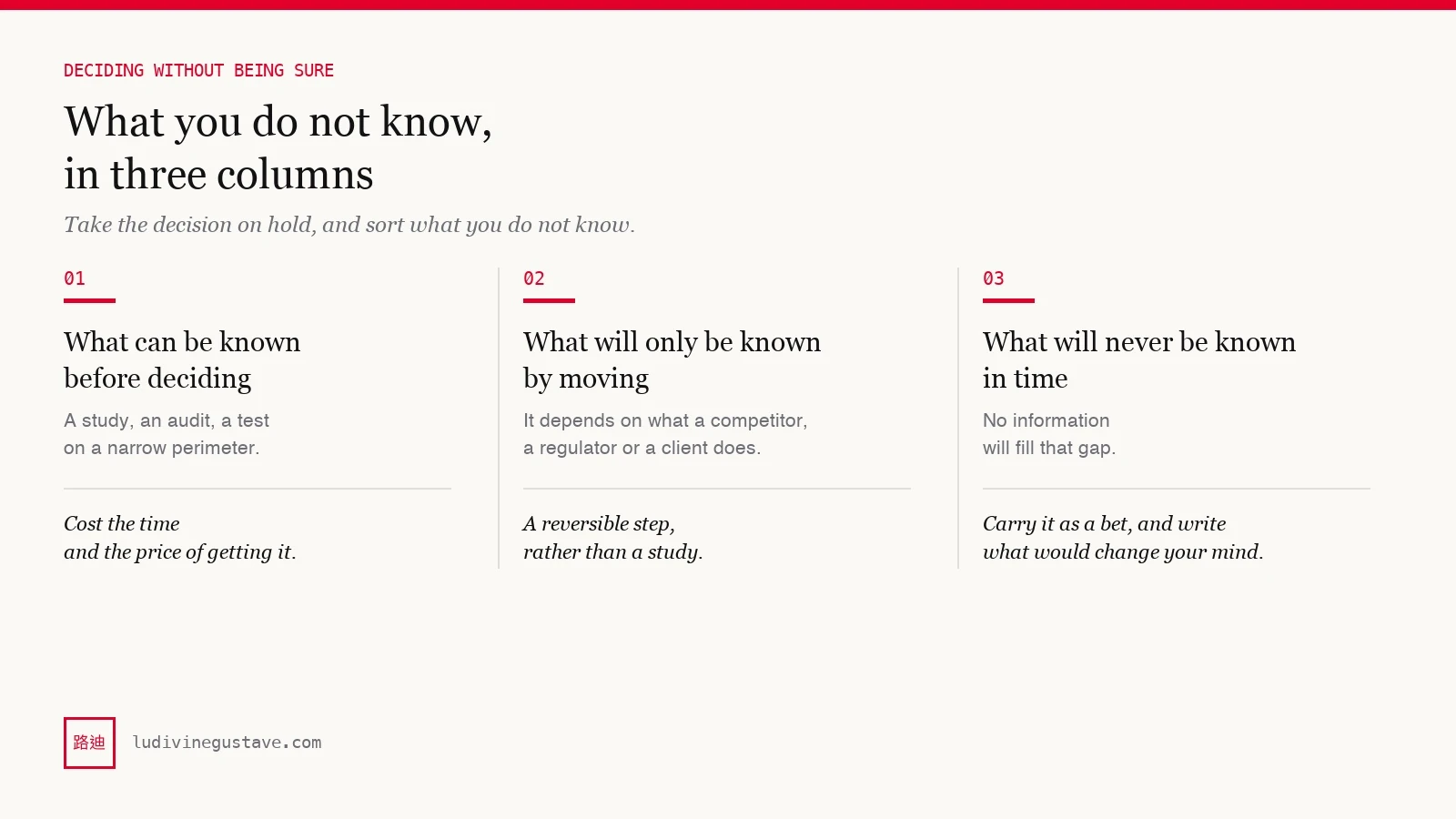
Worth copying onto the board at the start of the meeting.
The first time, the third column makes people uncomfortable. That is exactly its value. It makes visible what everyone knew without saying it, and it turns a vague wait into three distinct actions.
I have seen files frozen for eight months come unstuck in an hour through that sorting alone. Not because new information appeared, but because the room stopped waiting for something that was never going to come.
The part almost everyone skips
Writing down what would make you change your mind.
That is the piece teams leave out, and it is the one that protects them most. A decision that comes with its own exit signal is no longer a blind bet. It becomes a dated commitment, with a review clause.
Without it, two things happen. Either you cling to a choice that has gone bad, because reversing it would look like an admission. Or you change your mind every quarter, with nobody understanding why.
This is also what the Decision Architecture™ discipline works on: less about producing the right answer, more about making the way you decide legible.
What I take from the field
A decision is not judged on what was learned afterwards. It is judged on what was known the day it was taken, and on the quality of the reasoning held that day.
Many organisations do the opposite. They assess past choices in the light of what they know today, and draw the wrong lesson: that they should have waited. The next lesson is predictable. They wait a little longer still.
The question is for you, and for the people who decide alongside you.
The last file you pushed back, was it really waiting for information? Or was it waiting for someone to accept the risk of being wrong?
Related topics